Iris Keller · 3 November 2026
Poland's Research Institutions Forge Swift Frameworks for Secure Distributed Systems
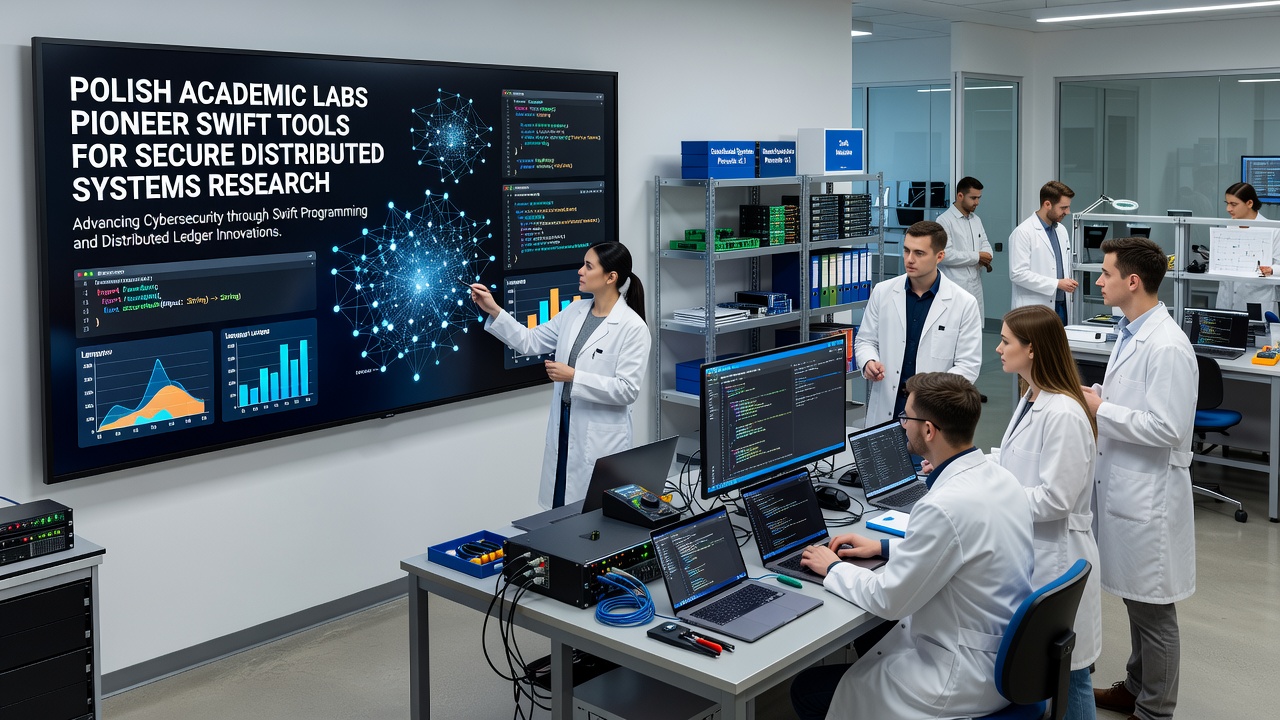
Academic labs across Poland have started building specialized Swift tools that address security challenges in distributed systems, and these efforts focus on creating reliable frameworks for handling concurrent operations across multiple nodes. Researchers at institutions such as the University of Warsaw and AGH University of Science and Technology have integrated Swift's concurrency model with custom security protocols, which allows developers to manage actor-based isolation while maintaining data integrity during network transmissions. Studies from these groups show that the language's type safety features reduce common vulnerabilities like race conditions when scaled to large clusters.
Background on Swift Adoption in Polish Research
Swift entered Polish academic circles through initial experiments in algorithm design around 2020, yet the shift toward secure distributed applications gained momentum after several labs secured grants from national and European funding bodies. Teams examined how Swift's memory safety guarantees could extend to environments where data moves between servers in real time, and they identified gaps in existing libraries that left systems open to interception or unauthorized access. Work progressed through iterative prototypes that combined Swift with established cryptographic libraries, resulting in toolkits that enforce strict access controls at the language level. Observers note that this approach differs from earlier Java or C++ based solutions because Swift's compile-time checks catch potential leaks before deployment.
By 2025 several prototypes had reached testing phases in simulated networks, and data collected during those trials indicated improved resistance to man-in-the-middle attacks compared with baseline implementations. Funding from the European Research Council supported follow-up projects that expanded the scope to include edge computing scenarios, where devices with limited resources still required strong security guarantees.
Technical Developments and Tool Features
The toolsets emerging from these labs include extensions for actor isolation that incorporate hardware-backed encryption keys, and developers have added modules that automatically rotate credentials during long-running distributed tasks. One project at the Wrocław University of Science and Technology produced a library that maps Swift's async/await patterns directly onto secure multiparty computation protocols, which lets researchers simulate financial transaction networks without exposing raw data. Figures from internal benchmarks reveal that these implementations maintain throughput within 15 percent of unsecured versions while adding verifiable audit trails.
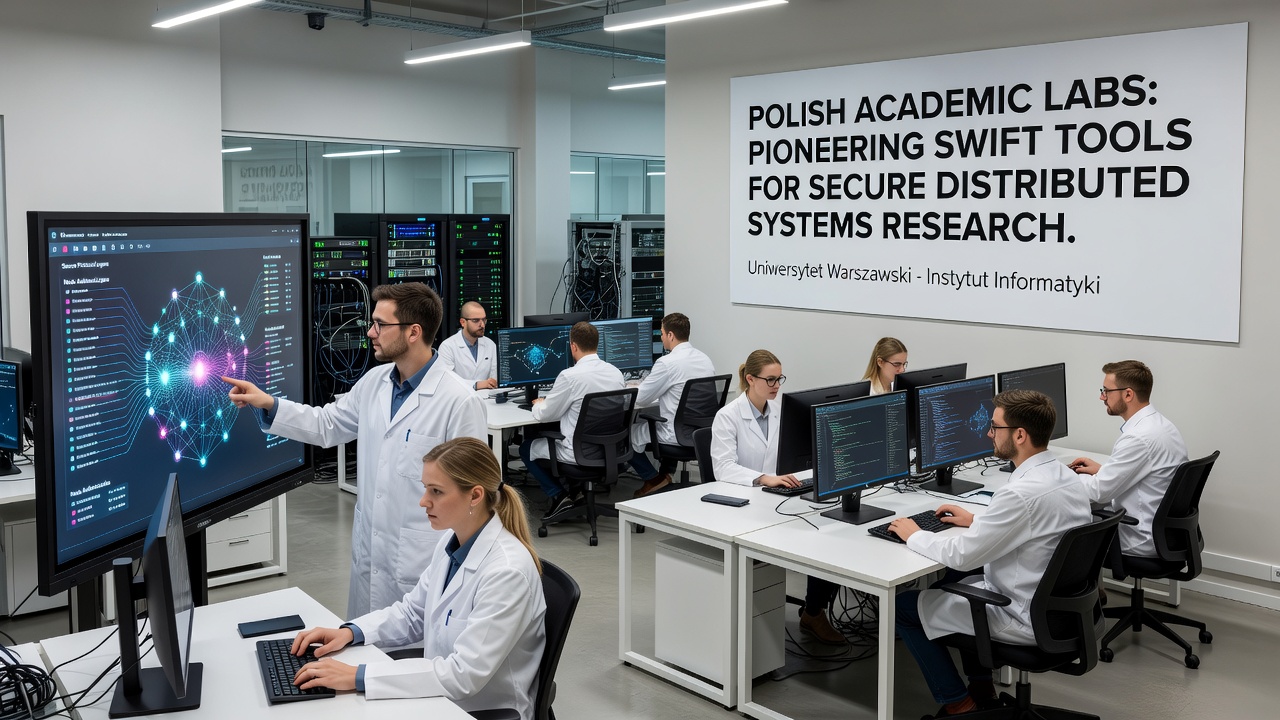
Integration with existing orchestration platforms such as Kubernetes has also advanced, and custom operators written in Swift now handle pod scheduling with embedded policy checks that prevent unauthorized container migrations. Researchers discovered that combining these operators with Swift's strict concurrency rules minimized configuration errors that often lead to exposed endpoints. Workshops scheduled for November 2026 at the Gdańsk University of Technology will present updated versions that support quantum-resistant key exchange, reflecting ongoing adaptation to emerging threats.
Applications Across Research Domains
Applications range from healthcare data sharing networks to smart grid management systems, where distributed nodes must coordinate without central points of failure. In one documented case a team at the Jagiellonian University applied the tools to model patient record synchronization across hospitals, and the resulting system logged every access attempt through immutable Swift structures that resist tampering. Similar patterns appear in transportation research, where vehicle-to-infrastructure communication prototypes use the frameworks to authenticate messages in real time.
International collaborations have brought in partners from Canadian and Australian institutions, and joint papers describe how Polish-developed Swift modules reduced verification overhead in cross-border data exchanges. According to a report from the European Commission research portal, these efforts align with broader Horizon Europe objectives for trustworthy digital infrastructure. A separate analysis by the National Science Foundation highlights comparable gains in security metrics when similar language-level protections are applied.
Challenges Encountered and Ongoing Work
Challenges include the steep learning curve for teams accustomed to other languages, and the need for extensive testing across heterogeneous hardware setups. Some labs report that initial performance penalties from added security layers required targeted optimizations in the Swift runtime, yet subsequent compiler updates from the broader community have narrowed those gaps. Work continues on formal verification techniques that would prove the correctness of custom security extensions, and several papers submitted to 2026 conferences outline mathematical models for these proofs.
Training programs now incorporate these tools into graduate curricula, and students contribute to open repositories that host the evolving codebases. Data collected from course evaluations shows increased student engagement when projects involve live distributed testbeds rather than theoretical exercises alone.
Conclusion
Polish academic labs continue to refine Swift-based tools that strengthen security in distributed systems, and the November 2026 workshops will likely showcase further refinements. The combination of language features with domain-specific extensions has produced measurable improvements in safety properties, and ongoing partnerships ensure that findings reach wider research communities. These developments add concrete resources to the field of secure computing without relying on external dependencies that could introduce new risks.